

I begin this essay with a bit of exposition on the profound and tremendous respect I have personally for a black man whose principles have shaped who I am and have continued to provide me with a sense of purpose and stability in my psychology since I was 8 years old. It is my great honor to write on, Marcus Garvey, who I believe is the most important and forward thinking black man to have existed in the past 300 years here upon this Earth. Even now in the modern day as we all scramble to find ourselves whether you are a black person from the African American community, the Caribbean community, or the African community. This man’s thoughts and ideas reverberate throughout our daily struggles and topics of discussion. He has single handedly and unquestionably created the framework for the 20th and 21st century black man to follow yet even to this day our diaspora as a whole have struggled to reproduce a figure who can even match the magnitude of this man’s unyielding mission and dedication to his people. There have been many notable men who have taken great inspiration from his writings, speeches, and projects for the reunification of our people such as Malcolm X, Kwame Nkruma, Steve Biko, Nelson Mandela,Thomas Sankara, Patrice Lumumba, Elijah Muhammad, and even Martin Luther King Jr. to name a few. Not to mention him being one of the cornerstones of the Rastafari Religious Movement and its profound effect on the Caribbean and African cultures for years to come. Marcus Garvey is widely regarded in Rastafari as a Prophet and part of the Holy Trinity of Emmanuel I, Haile Selassie, and Marcus Garvey.
The Creation of a Legend
Born Marcus Mosiah Garvey on August 17th, 1887 in St. Ann’s Bay, Jamaica. Marcus Garvey came up in a very poor, working class family. He was the last of 11 children born to his father Marcus Garvey Sr. and his mother Sarah Jane Richards. Marcus Garvey’s father worked as a stonemason, his mother worked as a domestic and farmer. Although Marcus Garvey Sr. was often known as a stern (perhaps even bitter) man he had a great influence on Marcus Garvey Jr. in his early life. Garvey once described his father as “severe, firm, determined, bold , and strong, refusing to yield even to the superior forces of life and circumstance. Garvey’s father was known to have a vast library of books which he had built up through his work as a stonemason. This was perhaps one of the greatest contributions to Marcus Garvey Jr’s. vast knowledge of African history. Garvey’s mother had a great influence on him as well. She was very supportive of him and it was her who came up with the idea to call him Moses after Moses of the Bible, a name he would come to be known as later on in his life. His mother’s support helped to give him his extraordinary sense of self confidence to lead.
Marcus Garvey Jr. had a complex relationship with his father. Garvey’s father was born a slave, his father worked his way up to being a professional mason and among his crafts he would often be contracted to create tombs in local graveyards. One day he took young Garvey with him to the graveyard to dig graves. As the story goes, at some point he had young Garvey go down into the grave but when he was inside Garvey’s own father pulled up the ladder and left him. Garvey cried out for his father but he left. Alone in the grave the young Marcus Garvey learned the only man he could rely upon was himself. His father seemingly wanted to teach him a lesson, it was a lesson he would carry the rest of his life.
As a boy Garvey imagined himself giving speeches to masses of followers in a story with him as the main protagonist. At this time in St. Ann’s Bay there were still a notable number of white inhabitants living in the area, most of which were from England being that Jamaica is a commonwealth of England. Unlike America the black and white inhabitants of the area had a much more interactive relationship albeit there still were class and race differences. When Marcus Garvey was a boy he became close friends with a white girl named Joyce Reary. As the two became teenagers however, young Garvey realized and learned his second greatest lesson. Joyce was sent away to England by her family and told never to speak to him again, because “He was a Nigger.” Garvey recalled this as the first time he heard and was made to be aware of this idea of being “Black” and what it truly meant in the world he lived in; this realization once again had a profound effect on him and his developing philosophy. He felt shut-out, he felt like he wasn’t good enough. The rest of his life would be guided by his determination to prove he was just as “good”, just as “capable” as any other race of men on earth because of this.
Due to the colonial education system he was forced to leave primary school by the age of 14. He went on to become a printer’s apprentice and quickly advanced to being a Master Printer. He learned the power of controlling the written word, a skill which would define his movements in later years. He soon published his first newspaper “Garvey’s Watchman.” In 1910 at the age of 23, Marcus Garvey set out on a journey throughout Central America. He supported himself as a journalist and worked as a laborer. In doing this he observed the amount of Afro-descended people working on plantations and building construction throughout Central America. In having discussions with them he quickly realized how the black man was the backbone of the workforce throughout the Americas but due to them being disconnected through language, land, and education they could never be unified properly. In 1914 he read a book that would change his life. Up From Slavery By Booker T. Washington. The reading of this book inspired Marcus Garvey in such a way he began to ask himself why Black People did not have a system of governance, any financial institutions, or means of creating wealth for their communities (all questions which even today are still prevalent in black communities and countries around the world.) This is where Marcus Garvey made a conscious decision to dedicate his life to the betterment of Black People globally.
The Beginning of a Lifelong Endeavor
By August 1914 Marcus Garvey had returned to Jamaica. He quickly became involved in local meetings and public speaking engagements. Upon attending one particular meeting he encountered an attractive 17 year old Amy Ashwood. He heard her powerful speech based upon the plight of the Jamaican people and black people worldwide, Garvey took a liking to her because of this and he knew they were kindred spirits. The two became romantically involved and decided to start what would be the legacy organization of the Garveyite Movement, the U.N.I.A (United Negro Improvement Association).
With the motto “One god, One Aim, One Destiny”. Both Garvey and Ashwood would go on to garner a small but loyal following, however problems soon followed. Garvey was greatly displeased with the “negro leaders” who were at the forefront in Jamaica at the time and labled them sellouts. He didn’t do well with dissent within his followers and was very bad with money management being cited as often using his funds for his own personal expenses. By the Spring of 1916 he moved to New York City leaving what was left of his following along with Amy Ashwood behind in Jamaica and made his voyage to America.
Although his ideas may have failed in Jamaica they would later find new life in America. He arrived in Harlem NYC and found a place to stay amongst a Jamaican family. He quickly found a job as a printer. He soon got the opportunity to deliver his first formal lecture due to a local businessman by the name of A. Philip Randolf who heard about Garvey’s work in Jamaica. Garvey printed his own handbills and rehearsed his speech tirelessly. This was the shot he had dreamed of since he was a little boy. However upon taking the stage in a packed ballroom filled with nervous anticipation Marcus Garvey’s first speech was a disaster. The words failed to leave his mouth correctly, he was visibly trembling and people began to laugh and ridicule him. He at one moment took a step forward to which he lost his balance and fell flat upon his face. The shame of this moment affected him greatly and he looked deep within himself, he began to rebuild his stage persona and speaking practices. After his crushing debut Garvey ended up wandering into the Tabernacle Church of Rev. Billy Sunday a white Evangelist preacher who attracted huge crowds. Billy Sunday’s particular speaking style was something Garvey would later model himself upon due to Sunday’s very athletic presentation. His arm movement and the tonality of his message were attributes that Marcus Garvey could see as the missing link to his carefully thought out speeches.
1917: The Year Marcus Garvey Comes to Form
By the year 1917 Marcus Garvey had made his way across America, via train he was able to witness the horrors of the Jim Crow era upon the poor and largely uneducated black populations spread throughout the country. Nestled into small enclaves surrounded by the Ku Klux Klan, brutality and injustice of the American Legal System, as well as widescale lynchings and racial travesties which characterized the era. On July 2nd, 1917 the city of East St. Louis exploded in the worst racial riots the country had ever seen, Thirty- Nine Whites and HUNDREDS of Black Americans were killed. All of this while America had just joined the First World War where black men were being sent off to Europe to fight for America. Black people were being murdered in some of the most barbaric acts seen since slavery, with instances of children being thrown back into flaming houses set on fire by white mobs, whole families being boarded up in their own houses before they were torched,and white mobs equipped with axes seeking out black men, women, or children to chop them.
Amidst all the horror and shock that was sweeping the nation upon the revelation of what had occurred in the city of East St.Louis. In the summer of 1917 Marcus Garvey once again found himself at the forefront with an opportunity to capture the minds of the black population who at this point was paralyzed by fear and submission. The negro leaders of the day such as W.E.B Dubois and others were preaching peaceful resistance and silent marches. It was here where Marcus Garvey found his following in America due to his more direct and militant approach which was attractive to black men and women after the horrors they had been trained to accept and endure since they were children. Black people were tired of being told to stand down and lay down, Marcus Garvey with his newfound confidence and Jamaican background was a refreshing voice amongst all the indoctrinated negroes of America many black people were so used to hearing and seeing.
In September of 1917 Marcus Garvey opened the first American Division of the U.N.I.A. Exactly the same way he did in Jamaica Garvey immediately set himself apart from the rest of the Negro leaders in the country by calling them “Weak” and “Self-Serving”. Although this naturally created many enemies of his movement Garvey was never afraid of what others thought of him for the momentum of his movement was now like a train you either stand in the way and get run over or stand aside. From this point Garvey started to gather a massive following and he began opening up divisions of the U.N.I.A I’m every major American city through his now vast and growing network with other similar minded black activists. Coining the term “Garveyite” as a way of distinguishing themselves from others.
Marcus Garvey began to hold meetings which were often regarded as part council and part evangelist gathering as they were attended by many eager and excited black families and people from all walks of life. Marcus Garvey taught black people to love themselves,he taught black people that they are beautiful. Whether they were a domestic, a janitor,a cook, or a carpenter,or any other manner of trivial profession he taught them to first take pride in themselves as Africans and Garveyites. In a sense he sold the Negro back to themself.
The Red, Black, and Green: The Creation of a Nation
“Show me the Race or Nation without a Flag and I will show you a people without any pride.”
hon. marcus mosiah garvey
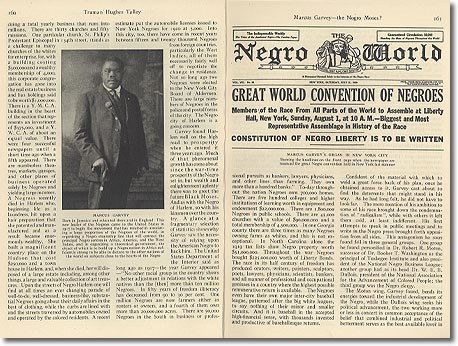
Marcus Garvey to many respects is not only the father of the concept of Pan-Africanisim but also the spark that ignited the greatly renowned period of Black American history called “The Harlem Renaissance”. By the year 1919 Garvey had established the Garveyite movement as a formidable establishment of Negro development and Improvement. Garvey had roles for one and all Men, Women, and Children. A uniform had been established that was worn proudly by any of its members, parades and marches were regularly held as events to promote Negro businesses and develop relationships and partnerships. Marcus Garvey had created the Pan-African flag which is still world renowned to this day throughout America, the Caribbean, and Africa often incorporated into many african nations color scheme the Red, Black, and Green flag. Marcus Garvey bought an old church in Harlem and converted it into the U.N.I.A’s Headquarters calling the building “Liberty Hall”, as well as establishing a newspaper with a cover charge of only 5 cents called “The Negro World” on the front page of every issue was a long editorial penned by none other than Marcus Garvey himself. The paper carried essays, black history, and articles on world events, there was none other like it at the time.
The paper was distributed with the help of Amy Ashwood (Marcus Garvey’s first love) who had finally made her way to New York from Jamaica the year prior. To draw in the dollars that flowed through the black community Garvey created the first of many investment funds. This would be the driving force that enriched Harlem and black communities across America to be Self-Sufficient. Their combined dollars would greatly benefit black businesses and commercial ventures such as Laundries, Restaurants, Newspapers, Barbers, etc. In turn these same businesses would help finance the U.N.I.A through another vehicle of this plan in the Negro Factories Corporation. At its peak U.N.I.A businesses employed over 1000 people.
Even though all of these revolutionary steps were taken, it was the people involved in the organization who once again began to exploit Marcus Garvey for his abundant faith in his people. Due to Marcus Garvey’s “come one, come all” model of structure where any and every black person could be involved and enabled to run businesses with little or no experience many U.N.I.A businesses began to flounder, to cover losses from one business he would shift funds over to the other to keep certain failing businesses afloat. Once again Garvey’s intolerance of dissent or challenge came to the surface; in one particular instance an organization member placed in a position to run a U.N.I.A business challenged Garvey and it resulted in Marcus Garvey physically assaulting him. Garvey was very authoritarian; his primary concern was loyalty not in competence which would spell problems later on to come.
The Dangers and Glories of Leadership
In October 1919, resentment and animosity from certain people in and around the organization began to boil over. One particular disgruntled investor by the name of George Tyler barged his way into the U.N.I.A headquarters demanding to speak to Marcus Garvey. Amy Ashwood was working there by this time, she was the first to address the man. Judging by his disturbed demeanor she was hesitant to allow him in but when Marcus Garvey heard the commotion brewing in the lobby he came forward to address the man. Marcus Garvey said “What do you want?” Upon Garvey’s appearance without a further word from George Tyler he pulled out a gun and began shooting. Amy Ashwood threw her body in between the shooter and Garvey in order to protect her lover and idol. The shooter yelled out very notably “Move I don’t want to shoot you! Just Garvey!” Miss Amy Ashwood then tackled George Tyler and tumbled with him down the front steps of the U.N.I.A headquarters. Upon hearing shots fired the neighbors called the police to which Geroge Tyler was apprehended and placed in jail in Harlem.
The newspapers quickly covered the story by saying Marcus Garvey had been slain by being shot in the head. Drama, confusion, and speculation ensued; in reality what had actually happened is that Marcus Garvey miraculously survived being struck by three shots from Mr. Tyler’s handgun. The next day a big speech had been arranged prior to the incident in Philadelphia and Marcus Garvey showed up to everyone’s shock and awe. Despite being shot the day before and bandaged he showed and it only served to increase the adoration and near worship now of him as a sort of larger than life figure. This incident actually benefited his public image greatly as he now became a legend.
Toward the end of 1919 Marcus Garvey’s newspaper The Negro World became the most popular negro newspaper in the United States and the U.N.I.A had over 750,000 followers. However his rise in fame and influence made him a target of the United States Federal Government otherwise known as the infamous F.B.I run by none other than the disruptive J. Edgar Hoover. This accompanied by the growing number of black critics and enemies of Garvey created a dangerous precedent for the coming years.
Africa for the Africans
“A man without knowledge of self is like a tree without roots.”
hon. marcus mosiah garvey
It was now the end of World War One and the colonial powers were once again reshifting their focus on dividing what territories they claimed were theirs at the Treaty of Versaille. Marcus Garvey made headlines by voicing the necessity for Africa to be returned to black people with the famous slogan “Africa for the Africans” which was placed on the front page of The Negro World Garvey’s now famous newspaper. Some thought it was a ridiculous fantasy, however as his sentiments started to reverberate throughout the colonies and the world the Europeans began to listen and see him as a threat. Garvey’s newspaper was now published in spanish, french,and english. Garvey’s message of revolution was now of primary concern to the British Colonial Empire which by this point was showing its first cracks after the incredibly destructive WW1.
“Africa is for the Africans!”
hon. marcus mosiah garvey
His newspaper was banned throughout the Caribbean, and Africa by order of Britain, France, and the rest of the colonial powers of Europe.The Negro World had to be smuggled into Kenya by black seamen and read aloud by whoever had a copy to the local populations. Anytime an issue made it to Africa many would rush to listen to every word printed on its pages like a sort of secret gathering, young boys in particular were charged with memorizing each editorial so Garvey’s words could be spread even without the proof of having an issue. Despite how many measures were taken to suppress the African spirit it only served to spread the legend of Garvey throughout the black world evermore.
Needless to say a certain federal agency (F.B.I) now made Marcus Garvey and his U.N.I.A a primary concern. With the use of agents attending his now notorious speeches documenting and gathering intelligence on his daily life. J. Edgar Hoover’s determination to dismantle Garvey now became a vendetta, leading the F.B.I to hire its first full time black agent in the Bureau’s history. The writing was on the wall for betrayal soon to come.
A Dream Betrayed
As Garvey’s enemies grew and government campaigns aiming to dismantle his movement started to operate; Garvey would embark on his most ambitious and ultimately fateful endeavor, The Black Star Line. There were many reasons as to why Marcus Garvey came up with the idea for a black owned and operated ship line in 1919. On paper it was a magnificent idea, Negros were routinely discriminated against when it came to international travel. Often given the lowest accommodations having to sleep in the darkest and most unsuitable corners of ships at the bottom of the hull near the boiler room, black people on ships had to eat after the white people had finished eating, often being left with fewer options. The ships would not only serve to transport black people to other black nations, but serve to help with commercial trade as well. Allowing negros worldwide to build a natural relationship with each other through mutual trade without being regulated by the white man so extensively. It represented the ability of blacks worldwide to have their own economy and through doing so establishing their own independence and freedom.

In November of 1919 Marcus Garvey shocked the world with the purchase of the S.S Yarmouth a 33 year old wartime steamer boat and had a grand departure from New York Harbor. The boat would have an all black crew of sailors as well as a black Captain by the name of Joshua Coburn. The grand spectacle of this departure from the New York Harbor attracted black people from all over the city in a massive display of joy and jubilation as the ship pulled out with Mr. Garvey himself and several of his contributors and notable figures aboard waved at the crowd from the hull. In truth this was just a hopeful spectacle as the ship had not been fully paid off yet, since this was so the maiden voyage of the SS. Yarmouth was only allowed to go as far as the 23rd st. pier. The SS. Yarmouth was paid off months later and when it finally made its true maiden voyage it was a moment of international celebration. The president of Cuba threw a banquet and donated large sums towards the expansion of the Black Star Line. Throughout the Caribbean including places like Costa Rica black dock workers would rush to the docks awaiting any sign of the Black Star Line approaching. Some would wait for hours, days,months, and years. Unfortunately Mr. Garvey’s ships would never reach such remote destinations.
Marcus Garvey was betrayed by the same few people he had placed his trust in to get the Black Star Line afloat. The man who Garvey asked to inspect the Yarmouth turned out to be an informant for J. Edgar Hoover. Marcus Garvey’s handpicked Captain Josua Coburn convinced a naive Marcus Garvey to pay six times what the ship was worth and then took a kick back from the purchase price. Garvey raised money to buy several more ships but the damage had been done and it was a disaster for the movement and on Mister Garvey’s hopes and dreams. Trust had been lost that Mr. Garvey never could find again, even still he continued to work.
The U.N.I.A took in thousands of dollars a day, yet Marcus Garvey chose to live modestly in a 6th floor apartment in Harlem,he didn’t drink nor smoke. He spent almost all of his time working orchestrating the day to day needs and expenditures of the movement. Any spare time he had is recalled by his children stating he would mostly study African history and meticulously organize and reorganize a collection of Egyptian vases he had in his study. He spent little time with his children enjoying the things that other families might be doing in a home setting, but he always provided what they needed. His son Marcus Mosiah Garvey III once said “ I never saw my father laugh, he was very kind and he was always bringing things for us…but I never saw him laugh, he always looked serious.”
Marcus Garvey : The Struggle Continues 1920-1940 and Beyond
“I am accused of creating Dukes, Barons, and Knights but who gave the White Man a monopoly on social order?”
hon. marcus mosiah garvey
On August 1st 1920 thousands of U.N.I.A delegates from twenty five countries assembled in New York at Liberty Hall and Madison Square Garden at the behest of Marcus Garvey. Garvey would call this event the International Convention of the Negro Peoples of the World. It was an extraordinary public event of black excellence. This would establish a world stage of the black movement and to its effect that’s exactly what this event did, it gave the world a sort of black government in exile awaiting to claim its place as a respected nation within the world. Garvey would make several notable and grandiose declarations. Those including the desire to make Africa one expansive empire ruled by the Negro people. At this event one of the most important documents which would later produce the arguments for the American Civil Rights movement The Declaration of Rights of the Negro Peoples of the World was presented to the public. It was an important document that called upon the nations of Europe and the Americas to respect the rights of Black people around the world. Several actions Garvey would take created even more controversy however during this month-long event. Garvey’s “government in exile” appointed its own ambassadors, and even sent a message of support to the Irish Republican Army. He sent a team of engineers to Liberia to begin the construction of a Black Homeland. He charted a delegation to the League of Nations and argued for the transfer of colonies to U.N.I.A rule.

At the precipice of the event Marcus Garvey in one of his greatest speeches declared that the displaced black peoples of the Americas and Caribbean would be returning home. It was cause for great celebration although it would ultimately be short-lived. Government agencies were closing in and after such grand displays of extravagance the organization forever plagued by its issues with mismanagement and the Black Star Line hemorrhaging money fast. Not all Black Americans agreed with such a display, and many including one of the first people whom Mr. Garvey interacted with when he came to America , A. Philip Randolf was recorded saying “Marcus Garvey has succeeded in making the Negro the laughing stock of the world.” With the likes of W.E.B Dubois openly criticizing Marcus Garvey as a buffoon.The internal black opposition gave the F.B.I its motive for clamping down further on such organizations as the U.N.I.A. tightening surveillance on Marcus Garvey’s daily activities, placing agents within the U.N.I.A and sabotage on the Black Star Line. All of this however was not the only catalyst for the downfall of the movement. The Black Star Line and the mismanagement that was occurring upon his ships would frustrate Marcus Garvey to make the mistake the F.B.I needed to take legal action against him. With stories of ship captains taking vast detours to go visit their wife while enroute, another had a nervous breakdown and tried to sink his own ship. Marcus Garvey upon inspecting the chaotic conditions on one ship got into a fist fight with the captain and fired half of its crew. Garvey looked for people who would be personally loyal to him and with things quickly spiraling out of control Marcus Garvey would confide in Herbert Bulin who was actually a federal agent placed close to Garvey. He got closer to Garvey than anyone else was able to.
Once noting that Garvey confided in him that he had thought about suicide often.
Ultimately the most convenient and only charge they could bring against Mr. Garvey was Federal Mail Fraud when Garvey had sent out brochures for yet another new addition to the Black Star Line asking for donations. On the brochure he used an image for a ship he hadn’t actually purchased yet. In doing so some said this was a misrepresentation “false advertising” of assets and the federal government leapt upon the opportunity to imprison Marcus Garvey and three other of his associates for five years.The trial was disastrous for Marcus Garvey, on the first day of his trial Marcus Garvey fired his legal team and chose to represent himself, believing his speaking skills would help him win over the court. While Marcus Garvey’s other two accused associates were aquitted, the overwhelming number of former U.N.I.A associates who entered the courtroom to testify against him would ultimately cause the jury to find him guilty of defrauding one man by the name of Benny Dansey of twenty-five dollars. In February,1925 after two years of appeals from Mr. Garvey. He was brought to the Atlanta Federal Penitentiary as prisoner #19359 with his only personal assets being Forty Dollars and a few hundred shares of his own worthless stock.
Marcus Garvey had been railroaded by the American Legal System. During his years in jail Marcus Garvey composed the song “Keep Cool” to sooth his loyal followers who were still fighting for his release. During this time Marcus Garvey’s health began to deteriorate, he had weak lungs and suffered from heart disease. Due to his importance to black movements which were now taking root across the world the U.S Government began to realise the potential for him to become a martyr if he died in prison. They did not want this and decided to release him on November 18th 1927 when Garvey was pardoned by President Calvin Coolidge. He was immediately deported back to Jamaica after Eleven years and tremendous work he had accomplished in the United States. He had nearly nothing to his name. He returned to Jamaica married to his second wife Amy Jakes Garvey and had two sons. He received a hero’s welcome at first but as time went on Garvey struggled to find work. He tried his hand at elective office, an amusement park, a collection agency, and a newspaper. An American court then took control of all of his assets and ALL U.N.I.A property from New York to Kingston. He was forced into bankruptcy, Marcus Garvey became ridiculed in Jamaica even faceing heckling from children. Heartbroken Marcus Garvey decided to move to London,England with his family in 1935.
In England during what would be his final years Marcus Garvey was successful in holding a number of speaking engagements, and even publishing a newspaper. A small number of his most loyal followers managed to relocate to Liberia in Africa fulfilling one of Marcus Garvey’s dreams. Unfortunately the majority of his followers in the United States dwindled down to just a small number who would meet in secret as the government imposed all kinds of penalties for engaging in any form with the now curse word U.N.I.A, including job loss, and persecution. However his asthma and heart disease continued to worsen and in January 1940 Marcus Garvey had a stroke. He became incapacitated, a columnist by the name of George Padmore for the Chicago Defender wrongfully reported based upon a rumor that Marcus Garvey had died. In the newspaper column the writer stated in a premature obituary that Marcus Garvey’s followers had “Deserted Him” and that he had died “Broke, Alone, and Unpopular”. Somehow the newspaper got into Marcus Garvey’s hands while he was in his London home. Upon reading his own obituary Marcus Garvey let out a loud moan, collapsed and suffered a second stroke, he died the next morning. The date was June 10th 1940.
In a cruel irony in his 53 years of life, Marcus Garvey never actually set foot in Africa. Even today Ninety Eight years after Marcus Garvey’s forced departure from America his ideas and motivations remain relevant to Black peoples across the world. His example and selfless dedication to his people and the movement should be remembered and used as a blueprint to addressing the problems of Negro people the world over. This is the reason why the Honorable Marcus Mosiah Garvey shall never be forgotten in the history books of the Negro people, and this little contribution to documenting this Monumental Man is my small way of ensuring his message can be passed on for generations to come.
“In death I shall be a terror to the foes of Negro liberty! Look for me in the whirlwind, or the song of the storm, look for me all around you.”
hon. marcus mosiah garvey
Primary Source:
Thanks to IBW21ST for this well documented coverage and first hand accounts of those who lived during the time of Marcus Garvey, this article was written based off this video and serves to keep this story alive.


 Wisdom And Royalty